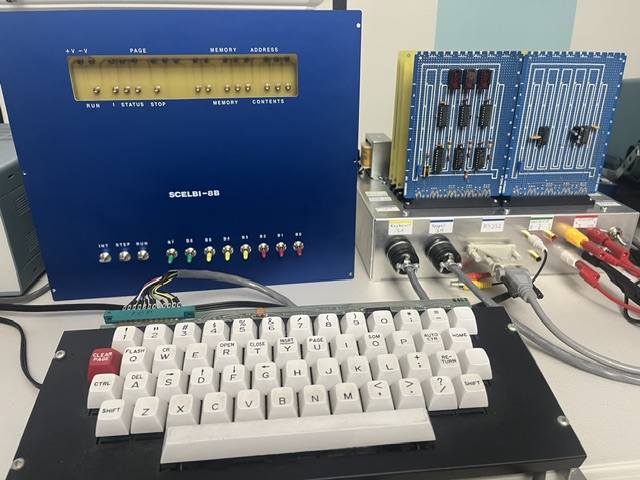
The Scelbi-8B was an improved follow-up to the Scelbi-8H, released by Scelbi Computer Consulting Inc. in 1975. Based on the Intel 8008 microprocessor, it offered greater memory expansion and more flexible I/O compared to the earlier 8H model. Marketed as a kit or assembled unit, it targeted hobbyists, experimenters, and early computer builders seeking more capable systems. In the MicroBasement, the Scelbi-8B represents the rapid evolution of microcomputers in the mid-1970s, bridging the gap between the limited 8H and the Altair 8800 era. This write-up covers its history, specifications, features, significance, and legacy.
Scelbi Computer Consulting Inc. was founded in 1973 by Nat Wadsworth and Bob Findley in Milford, Connecticut. The name is an acronym for "SCientific ELectronic BIological." After the Scelbi-8H (1974) showed promise but limited capabilities, Scelbi released the 8B in 1975 as an upgraded model with better expansion options. Advertised in electronics magazines like Byte and Radio-Electronics, the 8B was sold as a kit or fully assembled. Production was limited (likely a few hundred units total for both 8H and 8B), and the company shifted focus to software books by 1976–1977 due to higher profitability. Hardware production ceased around 1976, but Scelbi continued publishing until the early 1980s.
The Scelbi-8B was a compact, expandable system with improved specs over the 8H:
It supported basic I/O and could be programmed in machine language or with later SCELBAL BASIC.
The Scelbi-8B offered enhanced features compared to the 8H:
It was one of the first systems to allow users to build and expand their own computer with greater capacity and flexibility.
The Scelbi-8B used the Intel 8008 microprocessor as its central processing unit, with a simple bus architecture for memory and I/O. The front panel included switches and LEDs for direct machine-language programming and debugging. Programs were loaded via cassette tape or typed in manually. Expansion cards plugged into the backplane, providing additional RAM or I/O ports. It ran at 0.5 MHz, executing instructions from the 8008 instruction set, making it capable of basic calculations, control applications, and simple games. The 8B's improved memory and expansion made it more practical than the 8H for real-world use.
The Scelbi-8B was significant as an early commercial microcomputer kit, predating the Altair 8800 (1975) and inspiring the hobbyist computing movement. Its greater memory and expansion capabilities made it more usable than the 8H, appealing to electronics enthusiasts. Though limited production (likely a few hundred units total for both models), it helped popularize the Intel 8008 and paved the way for later 8080-based systems. Scelbi's pivot to software books (like SCELBAL) extended its influence.
The Scelbi-8B is a rare artifact of the pre-Altair microcomputer era, showing how early adopters embraced microprocessors. With improved capabilities over the 8H, it influenced DIY computing and software distribution models. In the MicroBasement, it represents the birth of personal computing, when enthusiasts built machines from kits and dreamed of what computers could become.