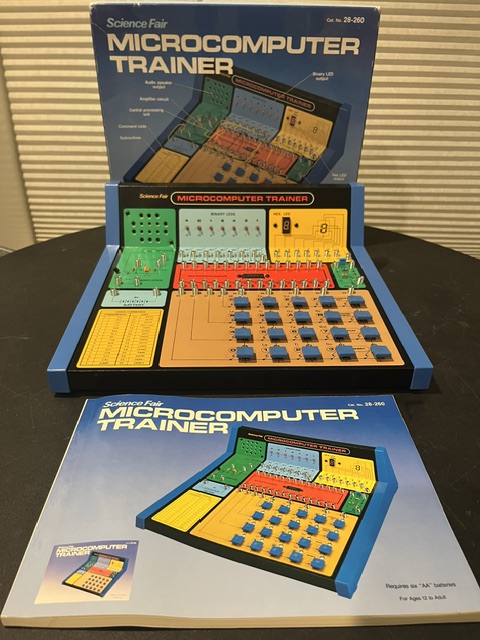
The Radio Shack Science Fair Microcomputer Trainer (catalog # 28-260), released in 1977, was an educational kit designed to teach microcomputer fundamentals to students, hobbyists, and aspiring engineers. Part of Radio Shack's Science Fair series, it provided a hands-on platform for learning digital logic, assembly language, and CPU operations. Priced affordably at around $40 - $50, it demystified computers during the personal computing boom, emphasizing the importance of understanding core principles. This write-up covers its specifications, projects, educational value, and competing products.
The 28-260 used a Texas Instruments TMS1000 4-bit microcontroller, one of the earliest single-chip MCUs. Key features included:
The kit came with a detailed manual, schematics, and sample programs, making it self-contained for learning.
The 28-260 supported a variety of educational projects, focusing on hardware and software basics. The manual included step-by-step guides for 20+ experiments, such as:
Users could extend projects with add-ons like the Science Fair Expansion Kit, creating custom games or instruments.
The 28-260 emphasized hands-on learning of computer fundamentals, teaching CPU cycles (fetch, decode, execute), addressing modes, and instruction sets. In an era before user-friendly PCs, it showed how simple logic builds complex systems. Today's computers are highly complex, with billions of transistors and layered software, taking years to fully understand. However, starting with a basic trainer like the 28-260 provides a strong foundation - grasping registers, memory, and I/O makes advanced topics (e.g., modern CPUs or embedded systems) more approachable. It fosters problem-solving and curiosity, skills essential for STEM careers.
The 28-260 competed with other educational trainers in the 1970s - 1980s:
These trainers shared a focus on accessibility, helping bridge hobbyists to professional engineering.
The 28-260 inspired a generation of tinkerers, showing that computers are understandable machines. While superseded by modern microcontrollers like Arduino, it highlights the value of simple tools in education. In the MicroBasement, it demonstrates foundational computing principles, reminding us that today's complexity builds on basic logic.