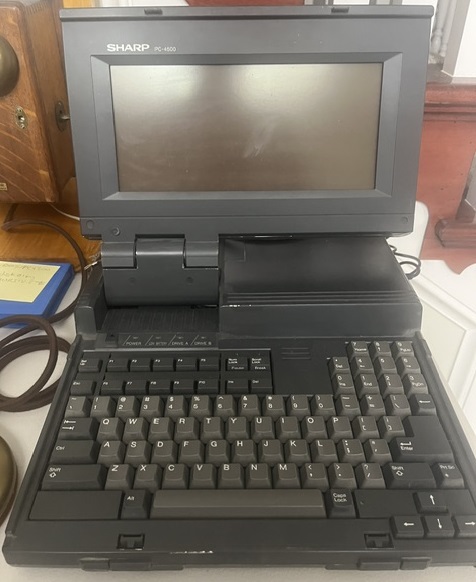
The Sharp PC-4500, released in 1987, was one of the early true portable laptops with a clamshell design and dual floppy drives. Marketed as a compact, battery-powered business machine, it targeted professionals needing mobility for word processing, spreadsheets, and data entry. Though heavy by modern standards, it represented a major step forward in portable computing—especially notable as the owner's first laptop.
Sharp Corporation of Japan, already a leader in calculators and LCD displays, developed the PC-4500 as part of its early portable computing line. The design focused on reliability and battery life, leveraging Sharp's expertise in LCD technology and compact electronics. It was one of the first laptops to include dual built-in 3.5" floppy drives, making it highly practical for data work on the go.
Introduced in 1987 at around $1,500 - $2,000 (depending on configuration), the PC-4500 was aimed at business users and early mobile professionals. It followed Sharp's PC-5000 (1983), one of the first clamshell laptops, but improved with dual floppies and better display. Production ran through the late 1980s, with thousands sold worldwide. It was less common than IBM compatibles but appreciated for its portability and Sharp's build quality.
The PC-4500 used an Intel 8088-compatible processor. Key features included:
The dual 3.5" floppies were a standout feature—allowing easy data swapping without external drives.
Came with MS-DOS 2.11, GW-BASIC, and utility software. The large LCD supported text-based applications like WordStar, Lotus 1-2-3, and dBase. The dual floppies made it practical for field work—e.g., sales reps carrying spreadsheets and reports. No hard drive standard, but external options existed. Battery life and weight were trade-offs for portability at the time.
The PC-4500 was a pioneering portable computer, bridging the gap between luggables (Osborne, Kaypro) and true laptops. Its dual floppies and LCD made it usable for business on the go, though the weight limited widespread adoption. As the owner's first laptop, it symbolizes the excitement of early mobile computing. Today, surviving units are rare collectibles, valued for their historical role in the transition to portable productivity. Modern enthusiasts restore them with CF adapters and LCD upgrades, keeping the Sharp legacy alive.