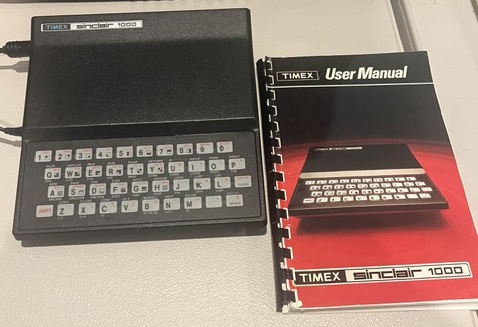
The Sinclair ZX81, released in March 1981, was a revolutionary ultra-low-cost home computer that sold over 1.5 million units worldwide. Designed by Sinclair Research under Sir Clive Sinclair, it was marketed as an affordable entry into personal computing, priced at just GBP 49.95 in kit form (GBP 69.95 assembled) - making it accessible to hobbyists, students, and families. Its extreme simplicity, tiny size, and minimalist design sparked a massive cult-like following and a thriving ecosystem of software, peripherals, and modifications. For many, including the owner who built one as a kit and later upgraded it with an external keyboard and AERCO FD-ZX dual floppy controller, the ZX81 represented pure DIY joy and creativity in the early 1980s.
Sinclair Research Ltd., founded by Sir Clive Sinclair in Cambridge, England, aimed to democratize computing with ultra-cheap, minimalist machines. The ZX81 followed the ZX80 (1980) and was engineered by Richard Altwasser and Steve Vickers to reduce cost while maintaining functionality. It used a Z80 CPU and a minimal chipset (mostly custom ULA), with RAM and video handled by just 1 KB of static RAM and clever software tricks. The machine's low price and TV output made it a sensation in the UK and beyond.
Launched at GBP 49.95 (kit) or GBP 69.95 (assembled), the ZX81 sold out quickly and became the first computer for many families. It was produced until 1983 - 1984, with Timex Corporation making licensed versions (Timex Sinclair 1000) in the US. Despite its limitations - black-and-white graphics, 1 KB RAM, membrane keyboard - the ZX81 inspired a huge community. By the mid-1980s, it was overshadowed by the ZX Spectrum, but its legacy endured.
The ZX81 used a Zilog Z80 CPU. Key features included:
The 1 KB RAM and slow cassette loading were major limitations, but the machine's simplicity encouraged creativity.
The ZX81 came with 8 KB Sinclair BASIC in ROM—compact but powerful for its size. Despite limited memory, a huge library of software emerged: games (e.g., 3D Monster Maze, Mazogs), utilities, and educational programs. The community produced thousands of titles on cassette, with magazines like *ZX Computing*, *Popular Computing Weekly*, *Your Computer*, and *Sinclair User* publishing type-in listings and reviews. The ZX81 developed a devoted cult following—users pushed the hardware to extremes, creating impressive demos and games in tiny memory. Forums and clubs thrived, and the machine's quirks became part of its charm.
The ZX81's edge connector invited expansions. Popular add-ons included:
German and European communities were especially active, creating dozens of add-ons, expansions, and modern recreations (e.g., FPGA-based ZX81 clones, enhanced RAM packs, and composite video mods). Forums like Forum.classic-computing.de, Planet Sinclair, and ZX81 Stuff document these projects.
The ZX81 was a cultural phenomenon - proving that powerful computing could be dirt-cheap and accessible. It inspired a generation of programmers and hardware hackers, many of whom later worked in the tech industry. Its cult following persists today, with active communities, modern reproductions, and preservation efforts. For many, including the owner who built a kit, added an external keyboard, and fitted an AERCO FD-ZX dual floppy system, the ZX81 remains a beloved symbol of early 1980s DIY creativity and fun.