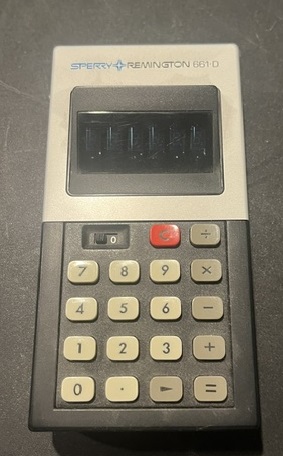
The Sperry Remington 661-D, released in the early 1970s, was an early hand-held electronic calculator from Sperry Remington (later part of Sperry Rand). It was a basic four-function model (addition, subtraction, multiplication, division), aimed at consumers and small businesses seeking portable arithmetic. Though not programmable or scientific, it represented the shift from mechanical to electronic pocket calculators in the post-slide rule era.
Sperry Remington, a division of Sperry Rand Corporation, was a major player in office equipment and early electronics. Known for typewriters and calculators, they leveraged their expertise to produce affordable, compact devices. The 661-D was part of Remington's entry into the booming hand-held calculator market, competing with Texas Instruments and Hewlett-Packard in the early 1970s.
Introduced around 1973 - 1974, the 661-D was priced at approximately $100 - $150. It followed the original 661 model with a revised case design. Production ran through the mid-1970s, with thousands sold as an entry-level pocket calculator. It was phased out as more advanced models with scientific functions and LCD displays emerged.
The 661-D used early LSI chips for basic operations. Key features included:
It was a non-programmable, non-scientific calculator focused on basic portability.
No software or programmability—the 661-D performed instant four-function calculations with a constant key for repetitive operations. Its innovation was compactness and battery power, making arithmetic pocket-sized. It lacked scientific functions, memory registers, or programmability, but its LED display and reliability made it a step up from slide rules.
The 661-D helped popularize hand-held calculators, bridging mechanical adding machines and advanced scientific models. As Sperry Remington's first pocket calculator, it showed the company's push into consumer electronics. Today, surviving units are collectible, valued for their role in the calculator boom. Restorers often replace batteries and LEDs, using them to demonstrate early portable computation.