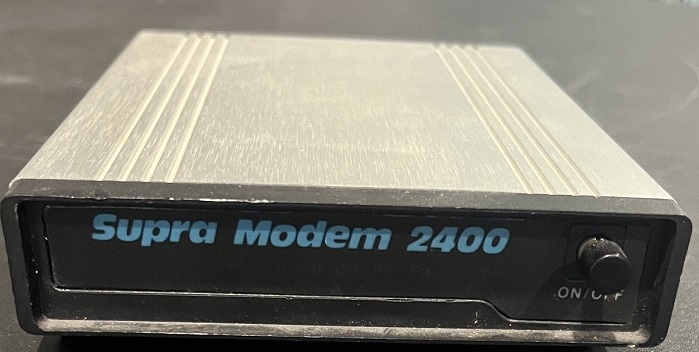
The Supra Modem 2400 was a popular external modem released in 1988 by Supra Corporation, offering 2400 baud speeds at an affordable price point. It helped democratize online access during the late 1980s boom in personal computing and BBS culture. In the MicroBasement, it represents the era when modems became consumer staples, enabling faster connections for emerging online services. This write-up covers Supra's history, product specs, cost, features, the growing modem market and competitors, and the increasing reasons to dial up.
Supra Corporation grew out of Microbits Peripheral Products (MPP), started in 1981 in Albany, Oregon, by high-school friends John Wiley and Alan Ackerman. MPP first sold Atari 8-bit interfaces and a 300 baud modem; after the mid-1980s Atari collapse they reorganized as Supra and moved into ST/Amiga hard drives, SCSI, and then PC modems. The Supra Modem 2400 (1987-1988) was the breakout: Hayes-compatible 2400 baud at a street price well under a Smartmodem 2400. The company later added fax and 14.4/28.8 models, moved operations toward Vancouver, Washington, and was bought by Diamond Multimedia in 1995. The brand faded after Diamond merged into S3 in 1999. Supra's mark was making fast dial-up cheap enough for hobbyists.
The Supra Modem 2400 was an external, Hayes-compatible modem with these key specifications:
It was backward-compatible with slower standards (Bell 103/212A, V.22).
The Supra Modem 2400 retailed for $199 - $249 in 1988 - 1989 (about $500 - $600 in 2026 dollars). This made it significantly cheaper than competitors like the Hayes Smartmodem 2400 ($499+), appealing to budget users and hobbyists. Street prices often dropped to $149 by 1990 as 2400 baud became standard.
The Supra 2400 offered competitive features for its price:
It was praised for affordability and compatibility, though sometimes criticized for build quality compared to Hayes.
By the late 1980s, the modem market exploded as BBSs, CompuServe, and AOL gained popularity. Competitors like Hayes (Smartmodem 2400), U.S. Robotics (Courier 2400), Zoom (Zoom 2400), and Practical Peripherals (PP2400) drove innovation and price wars. Supra differentiated with low costs and features like fax support, capturing budget segments. The market grew from $100M in 1985 to $1B+ by 1990, fueled by PC proliferation.
The late 1980s saw more reasons to connect: BBSs for file sharing and forums, online services like CompuServe for email/news, early Internet access via universities/providers, online banking prototypes, multi-player games (e.g., Doom precursors), and faxing. 2400 baud sped up transfers, making online time less costly (billed per minute). This era transitioned from hobbyist BBSs to the World Wide Web's emergence.
The Supra 2400 helped make modems affordable, accelerating online adoption. As competitors grew, it contributed to the dial-up boom. In the MicroBasement, it exemplifies the era's market expansion, when dialing up became essential for computing.