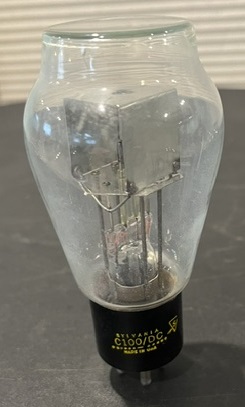
The Sylvania C100/DC is a compact, high-voltage rectifier vacuum tube used in early television receivers and high-voltage power supplies. It is a smaller, more modern successor to larger mercury-vapor rectifiers, designed for consumer and industrial applications. In the MicroBasement, this tube represents the transition from bulky wartime rectifiers to smaller, more efficient designs in post-war consumer electronics. This write-up covers the history of Sylvania, the C100/DC tube's function, specifications, time period of use, and its legacy.
Sylvania Electric Products was founded in 1901 as the Hygrade Lamp Company in Middleton, Massachusetts, and later merged with Nilco Lamp Works to form Sylvania in 1931. It became a major U.S. manufacturer of vacuum tubes, light bulbs, and electronics components. During WWII, Sylvania produced millions of tubes for military radios and radar. Post-war, it focused on consumer electronics, including TV tubes, radios, and early semiconductors. Sylvania was acquired by General Telephone & Electronics (GTE) in 1959, and the tube division continued under GTE Sylvania until the 1980s when vacuum tube production largely ended. Today, the Sylvania brand is owned by LEDvance for lighting, but its tube legacy remains in vintage and collector circles.
The Sylvania C100/DC is a high-voltage half-wave rectifier tube, compact and designed for use in television receivers and other high-voltage power supplies. It features a glass envelope with a top cap anode connection, typical of high-voltage rectifiers. It was built to handle the high voltages needed for CRT anode supplies in early TVs.
The C100/DC was used as a high-voltage rectifier, converting AC to DC for the anode (high-voltage) supply of cathode ray tubes in television sets and oscilloscopes. Key specifications include:
It was designed for low-current, high-voltage applications, making it ideal for TV high-voltage supplies where current demands were minimal but voltage was extremely high.
The C100/DC was produced and used primarily from the late 1940s through the 1960s. It was common in black-and-white and early color television receivers, high-voltage power supplies for oscilloscopes, and some industrial X-ray equipment. By the 1970s, solid-state silicon rectifiers replaced most vacuum tube rectifiers in consumer electronics due to smaller size, no warm-up time, and greater reliability.
The Sylvania C100/DC is a classic example of compact high-voltage tube design in the consumer electronics era. Its small size and high PIV made it practical for TV sets, bringing high-voltage rectification into living rooms. In the MicroBasement, it serves as a reminder of the engineering challenges of early television - when tubes were still essential for generating the tens of thousands of volts needed to drive CRTs. Though long obsolete, it remains a collectible piece of mid-century electronics history.