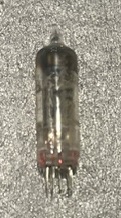
The Sylvania 6112 is a dual triode subminiature vacuum tube, one of the smallest practical amplifier tubes ever mass-produced. Developed in the early 1950s, it was designed for compact, high-reliability applications in military, aerospace, and early portable electronics. In the MicroBasement, the 6112 represents the final evolution of vacuum tube miniaturization before transistors largely replaced tubes. This write-up covers the history of Sylvania, the 6112 tube, its function, specifications, time period of use, and legacy.
Sylvania Electric Products was founded in 1901 as the Hygrade Lamp Company in Middleton, Massachusetts, and later merged with Nilco Lamp Works to form Sylvania in 1931. It became a major U.S. manufacturer of vacuum tubes, light bulbs, and electronics components. During WWII, Sylvania produced millions of tubes for military radios and radar. Post-war, it focused on consumer electronics, including TV tubes, radios, and early semiconductors. Sylvania was acquired by General Telephone & Electronics (GTE) in 1959, and the tube division continued under GTE Sylvania until the 1980s when vacuum tube production largely ended. Today, the Sylvania brand is owned by LEDvance for lighting, but its tube legacy remains in vintage and collector circles.
The 6112 is a subminiature dual triode - two triode sections in one tiny glass envelope. It was part of Sylvania's line of subminiature tubes developed for military and aerospace use in the early 1950s. The tube is extremely small (about 0.5 inches in diameter and 1.5 inches long), with flying leads (no base) for direct soldering into circuits. It was designed for high reliability, low power consumption, and operation in harsh environments (vibration, temperature extremes).
The 6112 was used as a low-power voltage amplifier and oscillator in compact electronics. Key specifications include:
It was prized for its low noise and reliability in critical applications.
The 6112 was produced and widely used from the early 1950s through the 1960s. It was common in military avionics, missile guidance systems, portable radios, hearing aids, and early space electronics. Production continued into the 1970s for replacement parts, but it was largely replaced by transistors and integrated circuits by the mid-1960s.
The Sylvania 6112 is a collector's favorite among subminiature tube enthusiasts. Its tiny size and dual-triode design made it ideal for compact, high-reliability circuits. Today, surviving 6112s are sought after for boutique audio amplifiers and vintage electronics restoration. In the MicroBasement, it stands as a testament to the miniaturization push of the 1950s - when vacuum tubes were shrunk to nearly the size of transistors, just before transistors won the race entirely.