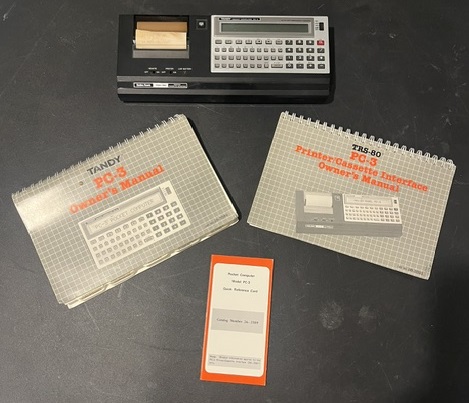
The Tandy Pocket Computer PC-3, released in 1983, was a compact, credit-card-sized programmable calculator/computer sold by Radio Shack. Marketed as an affordable ultra-portable BASIC machine, it targeted students, hobbyists, and professionals needing quick calculations or simple programs on the go. Though limited, it represented an early step toward true pocket computing.
The PC-3 (catalog 26-3589) is a rebadged Sharp PC-1251. Radio Shack sold several Sharp pocket computers under the Tandy/TRS-80 name. The larger PC-2 is the Sharp PC-1500; this PC-3 is the smaller SC61860 machine.
Introduced in 1983 at $99.95 (later reduced), the PC-3 was positioned as a cheaper alternative to the more capable PC-2 and a competitor to Casio and Sharp's own programmable calculators. It sold modestly but was overshadowed by larger pocket computers and the emerging home computer boom. Production ended around 1985 as attention shifted to newer models like the PC-4 and TRS-80 Model 100 portable.
The PC-3 used a Sharp SC61860 8-bit CMOS microprocessor. Key features included:
Weighed just a few ounces, easily fitting in a shirt pocket.
Full Microsoft BASIC in ROM supported floating-point math, loops, subroutines, and PEEK/POKE. Programs could manipulate the display and generate tones. A small library of commercial cassettes and user-written programs emerged for math, finance, games (e.g., simple adventure or dice simulators), and data logging. The Tandy 26-3591 printer/cassette interface added thermal printing and tape storage.
The PC-3 offered true programmability in an ultra-portable form factor years before modern PDAs or smartphones. It appealed to engineers, students, and early adopters wanting a pocket computer rather than just a calculator. While not a commercial blockbuster, it introduced many to BASIC programming and demonstrated the potential of battery-powered portable computing. Today, the PC-3 is a sought-after collectible among vintage pocket computer enthusiasts, with active communities sharing programs and building modern interfaces.