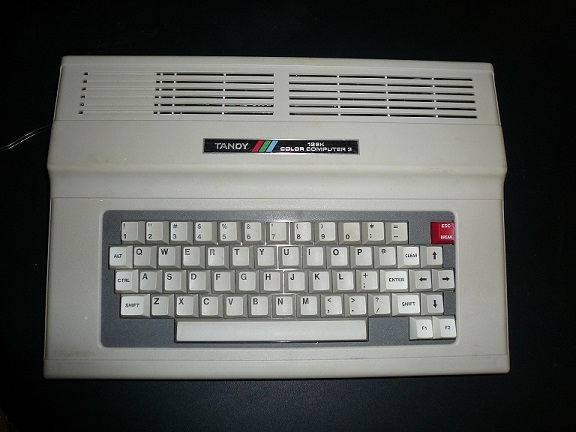
The Tandy TRS-80 Color Computer (often called the CoCo) had several models, but the 128K version—officially the Color Computer 3 (CoCo 3)—was released in July 1986 as the most advanced and capable in the line. It featured significantly more memory, improved graphics, and better performance, making it a favorite among hobbyists and developers for its versatility and expandability.
The CoCo series was developed by Tandy Corporation (Radio Shack) in Fort Worth, Texas. The original CoCo (1980) was designed by Motorola engineers and Tandy's team to compete in the home computer market. The CoCo 3 was a major redesign led by Tandy engineers, incorporating the Motorola 6809E CPU and a new video display generator (GIME chip) for enhanced capabilities.
Launched in 1986 at $219.95 (with 128 KB RAM), the CoCo 3 replaced the earlier CoCo 2. It addressed complaints about limited memory and graphics by adding 128 KB standard RAM (expandable to 512 KB or more), 640x192 graphics, and 64 colors. Tandy sold hundreds of thousands of units, with production continuing until 1991. The CoCo line as a whole sold over 700,000 units across all models.
The CoCo 3 used the Motorola 6809E microprocessor. Key features included:
Iconic gray case with rainbow logo.
Color BASIC 2.0 and Extended BASIC in ROM provided instant programming with advanced graphics commands (e.g., CIRCLE, DRAW, PLAY). The GIME chip enabled 256-color modes and hardware scrolling. Thousands of games (e.g., CoCo ports of arcade titles), OS-9 (multi-tasking OS), and applications were developed. The 128K RAM allowed larger programs and better multitasking with OS-9 Level Two.
The CoCo 3 was a cult favorite for its powerful CPU, expandability, and active community. It supported a thriving scene with magazines like Rainbow and Hot CoCo, and events like CoCoFests. Despite limited commercial success compared to Commodore/Apple, it excelled in education and hobbyist programming. Modern fans maintain emulators, FPGA recreations (CoCoVGA), and hardware upgrades (e.g., 512 KB RAM, SD card drives). The CoCo 3 remains one of the most capable 8-bit machines and a symbol of Tandy's innovative (if underappreciated) home computer efforts.