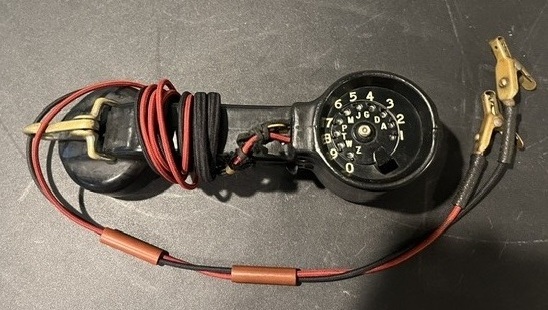
The pin dial lineman's handset, affectionately nicknamed the "GOAT" (Go Anywhere Telephone), is a specialized telephone tool used by telecommunications technicians for testing and troubleshooting phone lines. This rugged, portable device allowed linemen to "butt in" to lines for diagnostics, earning its common name "butt set." In the MicroBasement, it represents the ingenuity of early telecom tools. This write-up covers its history, years of use, how it worked, its toughness, and modern features.
The lineman's handset evolved from early 20th-century telephone test equipment. Western Electric (Bell System) produced models like the 1001 handset (ca. 1902), used by linemen for field testing. By the 1940s - 1950s, rotary dial versions became standard, allowing technicians to dial and monitor calls. These early sets, such as the Harris TS22 or Bell System rotary butts, featured a rotary dial for pulse dialing, a mouthpiece/earpiece, and test leads with alligator clips or bed-of-nails for tapping into lines. The nickname "GOAT" emerged among older linemen for its portability and versatility. By the 1970s, DTMF (touch-tone) keypads replaced rotary dials as phone systems modernized.
Rotary dial lineman's handsets were widely used from the 1940s to the 1960s/1970s, coinciding with the dominance of pulse dialing in telephone networks. By the mid-1970s, DTMF became standard, leading to keypad-based sets. The rotary era ended around the 1980s as analog systems transitioned to digital. Modern digital butt sets, with features like caller ID and DSL testing, began replacing them in the 1990s, though some rotary models lingered in legacy systems until the 2000s.
Linemen clipped the handset's test leads onto phone lines (e.g., at a pole or junction box) to monitor signals, test for dial tone, or make calls. The rotary dial allowed pulse dialing for troubleshooting switches or verifying connections. Technicians could listen for noise, check voltage, or "butt in" to active calls without disrupting service. These sets were essential for installing, repairing, and maintaining local loops in the Bell System era.
Built for field use, GOAT handsets were exceptionally tough and weatherproof. Constructed from durable plastic or metal casings, they withstood drops, rain, dust, and extreme temperatures. Features like sealed switches, rubberized grips, and shock-resistant components made them reliable in harsh conditions, from telephone poles to underground vaults. Their simplicity—no batteries needed for basic monitoring—added to their robustness.
Modern lineman's handsets (e.g., Harris TS52 PRO or Fluke TS54) have evolved significantly:
These additions make modern sets versatile for fiber, VoIP, and broadband, far beyond rotary dialing.
The GOAT handset symbolizes the grit of early telecom work. From rotary dials in the 1940s to digital tools today, it evolved with phone networks. In the MicroBasement, it highlights how simple, tough tools enabled complex systems.