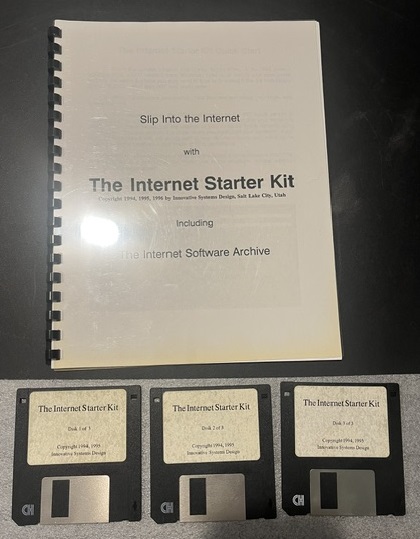
When public access to the Internet became available in the early 1990s, connecting was not an automatic thing. The OS for IBM compatible computers at the time was Windows 3.1, there was no built-in software for connecting to the Internet. Connecting to the Internet in the "old days" was difficult. It was a true catch 22 situation: you had to be connected to the Internet to download the software, yet home computers in those days were not connected! So how did people get connected?
In those days the Internet Starter Kit was the answer. I had access to the Internet since the mid to late 1980s before the general public had access. My good friend and business partner Jim had access to the Internet through the University of Utah. We both had Unix boxes at home that would call into the dial-in pool at the U. Jim had an arrangement where he would call in directly and pass traffic for a few friends. I would call into Jim's machine as he was a relay for my traffic. The early Internet was built in a way that many nodes were only connected when passing traffic. Dedicated lines and dialing up were expensive. Back in those days long distance calls were charged for by the minute. When dialed into Jim's computer we would pass USENET news, email, and ftp files. It was like magic, I could request a file off of a server somewhere in the world and the next day, thanks to UUCP, it would magically appear. UUCP is UNIX to UNIX copy, a service that would transfer files from one machine to another. From reading the USENET news groups I discovered that there was software available that I could run to connect my Windows 3.1 machine to the Internet.
I along with others created Kits of software that could be used to install all the required software to get anyone connected to the Internet, given you had an account to dial into. In order to distribute the software I emailed each Author or group for permission. I was not selling their software, I could only charge for the floppy disks, a printed manual, and the program I wrote to automatically install the software onto Windows. All of the software distributed with my kit was freeware, shareware, or public domain.
The foundation for everything was Trumpet Winsock. The Winsock was a dialer and the TCP/IP stack that would manage the actual dialup connection, DNS lookups, and anything necessary to move packets from the applications on the desktop to one's Internet provider and beyond. My Internet kit had a setup program that took all of the users account information, username, password, dial in number, dns server and configure Trumpet Winsock. This made everything simple and transparent to the users. Today, maybe except for a username and password, protocols like DHCP manage all the underlying details of the connection.
The kit included a curated selection of software from the early 1990s, each serving a specific role in the Internet experience. Here's an elaboration on each piece, with approximate release timeframes:
The window for the Internet Starter Kit would begin to close when Windows 95 was released in 1995. Windows 95 was the first version of Microsoft's operating systems that included the necessary software, a TCP/IP stack and applications, to access the Internet. No longer would consumers have to be a computer wiz to connect to the Internet. Supporting software built-in to Windows 95 included the Winsock TCP/IP stack (for networking), Internet Explorer (web browser), and command-line tools like ping, telnet, ftp, and tracert. At that time even though getting on the Internet became much easier most people had no reason to jump on the Information super highway, that would take another decade. Whenever I flew I would often sit between two other passengers whom neither had an email address, or even a clue what the Internet really was.
Today the Internet is automatic. Nearly everyone and everything is connected to the Internet. In many ways you are forced to be on the Internet. From Shopping, scheduling medical appointments, banking, government services, school registration and even attending class it is universal. From the humble beginnings of three diskettes to today's ubiquitous state the Internet is truly everywhere.