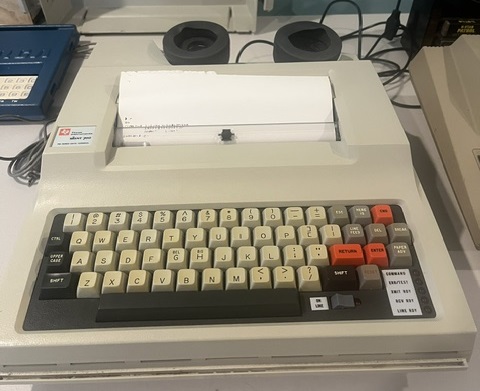
The TI Silent 787 was a thermal printing terminal introduced by Texas Instruments in 1977 - 1978, designed for quiet, reliable data entry and output in office, laboratory, and educational environments. Part of TI's Silent 700 series, it combined a thermal printer with a keyboard and modem interface, making it one of the earliest "silent" (non-impact) terminals available. In the MicroBasement, the Silent 787 represents the transition from noisy teletypes to quieter, more practical terminals for dial-up and data communications. This write-up covers its history, specifications, features, how it worked, significance, and legacy.
Texas Instruments (TI) launched the Silent 700 series in the mid-1970s to address the noise and maintenance issues of impact printers like teletypes. The Silent 787, introduced around 1977 - 1978, was an enhanced model with improved speed and features over earlier models like the 733 and 745. It was marketed for data entry, time-sharing systems (e.g., CompuServe, The Source), and educational use. TI produced the Silent 787 through the early 1980s, with production tapering as CRT terminals and personal computers took over. The Silent 700 line was widely used by businesses, universities, and early online services.
The TI Silent 787 was a compact, desktop terminal with these key specs:
It supported ASCII, half/full duplex, and various baud rates.
The Silent 787 offered practical features for its time:
It was designed for portability and quiet operation, ideal for offices and classrooms.
The Silent 787 used a thermal printhead that selectively heated spots on special thermal paper to create characters. Data came via RS-232 serial input (from a computer or modem). The acoustic coupler allowed connection to a telephone handset for dial-up to time-sharing systems. The terminal translated incoming ASCII data into printed output, with no screen buffer—everything was printed immediately. It supported basic control codes for formatting (e.g., carriage return, line feed). The thermal mechanism was simple, reliable, and silent compared to impact printers.
The Silent 787 was significant for bringing quiet, reliable terminal access to non-industrial environments. It enabled users to connect to early online services (e.g., CompuServe, The Source) without the noise of teletypes. Its thermal printing reduced maintenance and consumables costs. It was widely used in education (universities, schools), business (data entry), and by hobbyists for BBS and time-sharing. It bridged the gap between teletypes and CRT terminals.
The TI Silent 787 is a classic example of 1970s terminal design, showing how thermal printing and acoustic coupling made computing more accessible. Though replaced by CRT terminals and PCs in the 1980s, it influenced portable and quiet printer designs. In the MicroBasement, it demonstrates the evolution of data terminals, from noisy impact to silent thermal, and the early days of dial-up access.