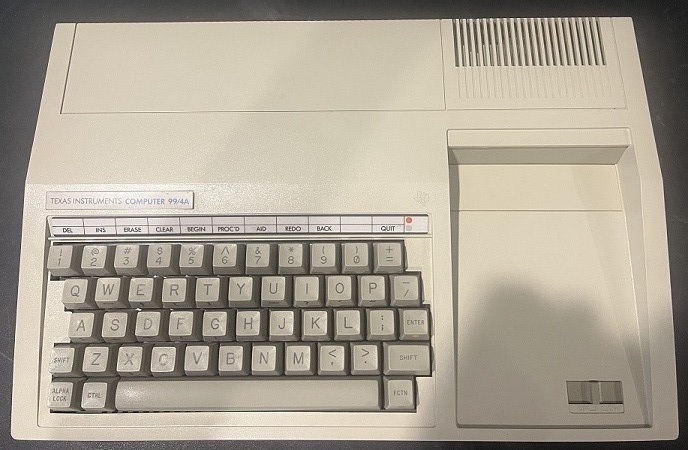
The Texas Instruments TI-99/4A, released in June 1981, was an upgraded home computer based on the original TI-99/4 (1979). It featured improved graphics, sound, and expandability, targeting families and educators with its cartridge-based software system. Despite innovative hardware, limited third-party support and competition from Commodore and Atari led to its discontinuation in 1984, though it retains a dedicated following.
The TI-99/4A was designed by Texas Instruments' consumer products division, leveraging TI's expertise in integrated circuits. TI, a pioneer in semiconductors, invented the first IC in 1958 (Jack Kilby) and developed early 4-bit processors like the TMS1000 (1971), used in calculators. This IC background allowed TI to produce custom chips for the 99/4 series, reducing costs but limiting compatibility.
The original TI-99/4 (1979) was the first 16-bit home computer but suffered from high price ($1,150) and limited software. The 99/4A addressed this with lower cost ($525 at launch, dropping to $99 in price wars) and fixes like lowercase support. TI's aggressive pricing sparked 1983's home computer wars but led to losses, ending production in March 1984 after ~2.8 million units.
The TI-99/4A used TI's own TMS9900 microprocessor. Key features included:
The Peripheral Expansion Box (PEB) chassis added floppy drives (90-360 KB), RS-232, parallel, and more interfaces.
TI BASIC in ROM for immediate use. ROM cartridges (solid-state modules) were the killer feature—plug-and-play games/education (e.g., Parsec, Alpiner, TI Extended BASIC). Bundled software and speech synthesizer add-on enhanced appeal. Over 300 cartridges released, though limited third-party due to TI's closed system.
The TI-99/4A introduced many to 16-bit computing and programming, with strong educational focus. Its cartridge system influenced Nintendo NES. Price wars killed profits but made computing affordable. A passionate community thrives today, with modern expansions (SD cartridges, HDMI, TIPI network). The 99/4A symbolizes TI's bold but flawed entry into home computing, leaving a unique legacy in retro circles.