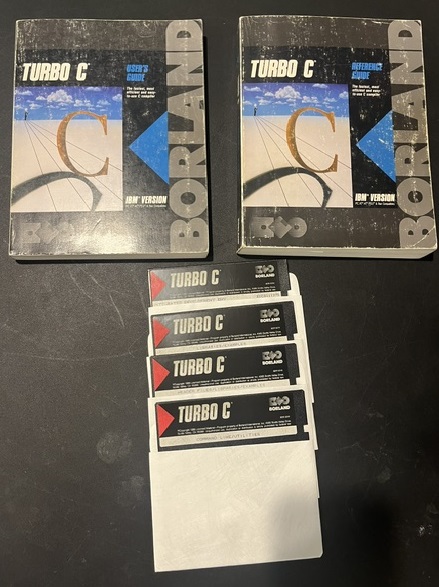
Borland Turbo C 1.0 was a groundbreaking C compiler released in 1987 by Borland International, designed for the IBM PC and compatibles. It revolutionized software development with its integrated environment, speed, and affordability. In the MicroBasement, Turbo C 1.0 represents the democratization of programming tools in the late 1980s, enabling hobbyists and professionals to create efficient code without expensive hardware. This write-up covers the history of Borland, Turbo C's features, its competitive pricing, memory models, Borland's other products (specializing in languages and IBM PC applications), and its legacy.
Borland International was founded in 1983 by Niels Jensen, Ole Henriksen, Mogens Glad, and Philippe Kahn in Scotts Valley, California. Starting with a $100,000 investment, Borland focused on affordable, high-quality software tools for the emerging IBM PC market. Kahn, the charismatic CEO, emphasized innovation and aggressive marketing. The company specialized in programming languages and development tools, becoming a rival to Microsoft in the 1980s-1990s. Borland grew rapidly, peaking at $500 million revenue in 1993, but faced challenges from Microsoft's dominance. It rebranded as Inprise in 1998, then back to Borland in 2001. Acquired by Micro Focus in 2009, Borland's tools live on under Embarcadero Technologies.
Turbo C 1.0 introduced features that set it apart:
It ran on IBM PCs with 256KB RAM, making it accessible for home users.
Turbo C 1.0 retailed for $99.95 in 1987 (about $270 in 2026 dollars), undercutting competitors like Microsoft C ($450) and Lattice C ($500). This aggressive pricing made professional tools affordable, boosting Borland's market share and enabling students/hobbyists to develop software.
Borland specialized in programming languages and tools for the IBM PC line:
Borland's "Turbo" series made IBM PC development fast and cheap, fueling the software boom.
Turbo C 1.0's legacy is in democratizing C programming, influencing IDEs like Visual Studio. Its speed and integration set standards. Borland's focus on affordable tools empowered a generation of developers. In the MicroBasement, Turbo C 1.0 evokes the 1980s PC revolution, when compilers became personal tools, not corporate luxuries.