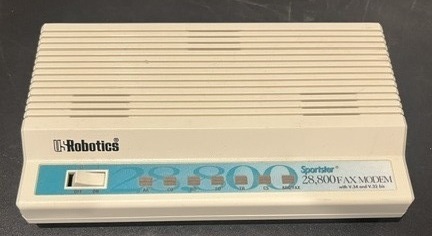
The USR Sportster 28,800 Fax Modem (often referred to as the Sportster 28800 or 288) was one of the most popular and affordable high-speed modems of the mid-1990s, released by U.S. Robotics in 1994 - 1995. Supporting the V.34 standard for 28,800 bps (with V.32bis fallback), it brought fast dial-up access to the masses during the explosive growth of BBSs, CompuServe, AOL, and the early World Wide Web. In the MicroBasement, it represents the "fast modem era" when 28.8k became the standard for home users before 56k modems arrived in 1997. This write-up covers its history, specifications, cost, features, market context, and legacy.
U.S. Robotics (USR) introduced the Sportster 28,800 in late 1994 as an affordable upgrade to their popular 14,400 models. It coincided with the widespread adoption of V.34 (ITU-T standard for 28,800 bps) and the rise of graphical web browsing with Mosaic and Netscape Navigator. The modem was in heavy use from 1995 to 1997, the peak of 28.8k dial-up. It remained popular into the early 2000s for legacy systems and areas with poor line quality, as V.34 was robust on noisy lines. By 1997 - 1998, 56k modems (V.90/V.92) largely replaced it, but many users kept their Sportsters as reliable backups or for faxing.
The Sportster 28,800 was an external modem with these key specs:
It was backward-compatible with all major standards (Bell 103/212A, V.22, V.22bis, V.32, V.32bis).
The Sportster 28,800 offered strong features for its price:
It was praised for reliability, ease of use, and affordability, making it a bestseller.
By the mid-1990s, the modem market was highly competitive as online services exploded. USR's Sportster line competed against Hayes Optima, Zoom, Practical Peripherals, Supra, and Diamond. Prices dropped rapidly, with 14,400 modems falling to $99 and 28,800 models to $149 - $199. The Sportster 28,800 stood out for value, reliability, and strong fax support, capturing budget users who wanted fast access without premium prices. The market grew from millions of users in 1990 to tens of millions by 1996, driven by BBSs, AOL, CompuServe, and the web.
The mid-1990s saw explosive growth in reasons to connect: graphical web browsing (Mosaic, Netscape), AOL's mass adoption, CompuServe forums, email (Eudora), file downloads (FTP), online gaming (Doom deathmatch precursors), and early e-commerce. 28,800 baud made web pages load in seconds instead of minutes, and compression squeezed more data through phone lines. This era marked the transition from text-based BBSs to the visual web, making modems essential for home users.
The USR Sportster 28,800 helped make fast dial-up accessible to the masses, accelerating the Internet's growth. It bridged the gap between expensive enterprise modems and consumer needs. In the MicroBasement, it exemplifies the mid-90s dial-up boom, when connecting became fast enough for practical use but still felt like an adventure.