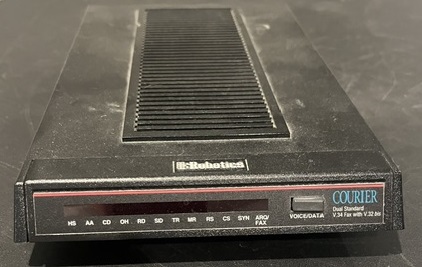
The USR Courier Dual Standard V.34 (often called the Courier V.34 or Courier 28800/33600) was U.S. Robotics' flagship high-performance modem of the mid-1990s, released in 1994 - 1995. It supported the V.34 standard for up to 28,800 bps (later upgraded to 33,600 bps) and was backward-compatible with V.32bis and earlier standards. Known for exceptional reliability, advanced features, and "bulletproof" performance on noisy lines, it became the modem of choice for BBS sysops, power users, and early ISPs. In the MicroBasement, it represents the pinnacle of pre-56k dial-up technology. This write-up covers USR's history, product specs, cost, features, market context, and legacy.
U.S. Robotics (USR) was founded in 1976 in Chicago, Illinois, initially focusing on acoustic coupler modems. By the mid-1980s, USR became a major player with reliable, high-quality modems. The Courier series, launched in the early 1980s, earned a reputation for robustness and long-term compatibility. USR's modems were favored by professional users and BBS operators for their stability. The company dominated the 1990s modem market until 1997, when 3Com acquired USR for $6.6 billion. The Courier line continued under 3Com and later USR branding, influencing modem design for decades.
The Courier Dual Standard V.34 was an external modem with advanced capabilities:
It was backward-compatible with all major standards (Bell 103/212A, V.22, V.22bis, V.32, V.32bis).
The Courier Dual Standard V.34 offered premium features:
It was renowned for "bulletproof" reliability, making it a favorite among BBS sysops and power users.
By the mid-1990s, the modem market was highly competitive as online services exploded. USR's Courier competed against Hayes Optima, Supra, Zoom, Diamond, and Practical Peripherals. Prices dropped rapidly, with 14,400 modems at $99 and 28,800 models at $199 - $299. The Courier stood out for reliability and features, capturing professional and BBS users, while cheaper models like Supra and Zoom targeted budget consumers. The market grew from millions of users in 1990 to tens of millions by 1996, driven by BBSs, AOL, CompuServe, and the web.
The mid-1990s saw explosive growth in reasons to connect: graphical web browsing (Mosaic, Netscape), AOL's mass adoption, CompuServe forums, email (Eudora), file downloads (FTP), online gaming (Doom deathmatch precursors), and early e-commerce. 28,800 baud made web pages load in seconds instead of minutes, and compression squeezed more data through phone lines. This era marked the transition from text-based BBSs to the visual web, making modems essential for home users.
The USR Courier Dual Standard V.34 was one of the most reliable and feature-rich modems of the pre-56k era, setting standards for performance and compatibility. It powered the BBS and early Internet boom for power users. In the MicroBasement, it exemplifies the peak of dial-up technology, when connecting became fast and reliable enough for practical daily use.