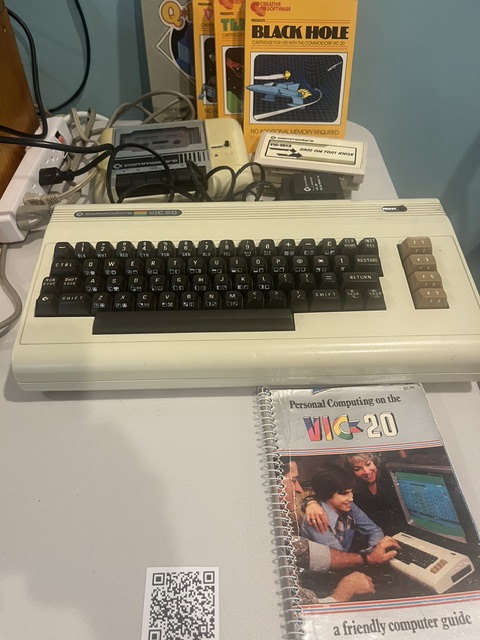
The Commodore VIC-20, released in 1981 (Japan 1980), was the first home computer to sell over one million units. Priced at $299.95 at launch, it brought color graphics, sound, and programmability to the mass market, proving that affordable computing could reach ordinary households. Often called "the friendly computer," it served as a gateway for millions into computing and gaming.
Designed by a team at MOS Technology/Commodore led by Robert Yannes (who later created the SID chip for the C64) and Al Charpentier (VIC video chip). Jack Tramiel, Commodore's cost-cutting CEO, demanded a low-price machine to compete with emerging Japanese color computers. The name "VIC-20" came from the VIC (Video Interface Chip) and an arbitrary "20" for marketing appeal.
Announced at the January 1981 CES, the VIC-20 hit stores in spring 1981. Aggressive pricing and heavy marketing (including William Shatner in TV ads asking "Why buy just a video game?") drove explosive sales. Over 2.5 million units were eventually sold. Production ended in January 1985 as the more powerful Commodore 64 took over.
The VIC-20 used the MOS Technology 6502 microprocessor. Key features included:
The distinctive wedge-shaped case held the board and keyboard; power was an external supply.
Microsoft BASIC 2.0 in ROM allowed instant programming. Thousands of games (e.g., Gorf, Omega Race, Radar Rat Race) and utilities were released on cartridge and tape. The cartridge port enabled fast-loading games and expansions like 16 KB RAM packs. Early programming magazines published type-in listings, teaching a generation to code.
The VIC-20 proved the viability of low-cost color computers, paving the way for the Commodore 64's dominance. It outsold rivals like the Atari 400 and Sinclair ZX81 in many markets and introduced computing to schools, families, and hobbyists. Its affordability democratized access, with many future programmers and engineers citing it as their first machine. The VIC-20 remains beloved in retro communities, with modern recreations like THEVIC20 and active homebrew development.